-
Self-directed investing, the Betterment way
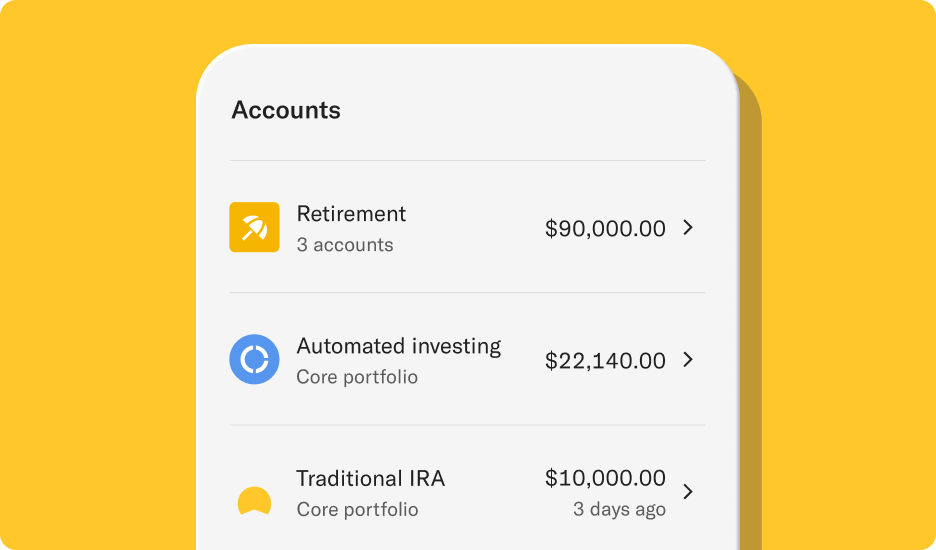
Self-directed investing, the Betterment way See what makes Betterment’s self-directed investing different from the rest. Plus, get three tips to help develop your own investing strategy. Key takeaways We surveyed our customers and learned that 75% of them use self-directed investing elsewhere, but many want it alongside their automated investing—so we built it the Betterment way. With Betterment, you can invest your way, buying and selling thousands of stocks and ETFs with no commissions. Manage your automated portfolios, cash accounts, and self-directed trades together on one platform for a fuller view of your finances. Unlike other investing apps, Betterment’s tax impact preview lets you see the impact of a sale before you trade, so there are no tax surprises. Invest smarter with these three tips: set clear goals, plan for taxes, and keep emotions out of your investing. Recently, we surveyed our customers and learned that 75% of them use some form of self-directed investing. That was eye-opening. While our automated investing tools are designed to take the work out of wealth building, many people still want the option to pick and manage certain investments on their own. So we asked ourselves: how can we bring self-directed investing to life—the Betterment way? Our answer: combine our award-winning platform with a customer-first experience to let you buy and sell thousands of stocks and ETFs with no commissions. With Betterment’s self-directed investing, you’ll get more investing choices, the ability to see all of your investments in a consolidated place, and tax insights you won’t find anywhere else. Investing your way, all in one place Not everyone invests for the same reason. We know this because we continually solicit feedback from our customers. Some customers told us they want to invest in companies they believe in. Others find it intellectually rewarding to follow markets and make trades. And many simply like having more control over their portfolio. With Betterment’s self-directed investing, you can get that flexibility while keeping everything on one platform. Manage your automated portfolios, cash accounts, and self-directed trades side by side, with technology designed to give you a clear view of your financial life. Tax insights you won’t get anywhere else Here’s where we’re really different than the typical “stock trading” platforms. Self-directed trading often means more frequent buying and selling, which can bring a hefty and unexpected tax bill at the end of the year that catches people off guard. In fact, when we asked our customers about their biggest challenge with self-directed investing on other apps, the top answer was “managing tax implications.” We solved that challenge. At Betterment, you’ll see a tax impact preview before you sell a stock or ETF. That preview includes how the sale could affect your taxes, and even potential wash sales. A wash sale occurs when you sell a security at a loss and then repurchase the same or a substantially identical security within 30 days before or after the sale, disallowing the tax deduction for that loss. With our tax impact preview, there are no surprises or guesswork. Just clear tax insights to help you make smarter decisions. (See how tax impact preview works.) Three tips to get started with self-directed investing Self-directed investing provides you with the choice to invest your way. But you get to decide what “your way” means. To help, here are three steps to get started: Have a clear goal before you trade: Don’t just buy because something looks hot or is in the news. Ask yourself: Am I investing for long-term growth, short-term income, diversification, or some other reason? Having a clear purpose can help you avoid making impulsive trades. Think about taxes before you sell: Selling a stock or ETF can trigger capital gains taxes. Short-term gains (for investments held less than a year) are usually taxed at a higher rate than long-term gains. Using tools that preview your tax impact before you trade—like Betterment’s—can help you avoid surprises. Avoid emotional trading: Markets move fast. It’s easy to panic-sell when prices dip or chase a stock that’s soaring. Instead, set rules for yourself—like only initiating a trade at pre-set price targets or sticking to a dollar-cost averaging plan—so emotions don’t dictate your decisions. Plus, at Betterment, your trades are queued for execution and not made immediately, but they are made in a timely manner, limiting your ability to try to “time the market.”
-
What’s an IRA and how does it work?
What’s an IRA and how does it work? Learn more about this investment account with tax advantages that help you prepare for retirement. An Individual Retirement Account (IRA) is a type of investment account with tax advantages that helps you prepare for retirement. Depending on the type of IRA you invest in, you can make tax-free withdrawals when you retire, earn tax-free interest, or put off paying taxes until retirement. The sooner you start investing in an IRA, the more time you have to accrue interest before you reach retirement age. But an IRA isn’t the only kind of investment account for retirement planning. And there are multiple types of IRAs available. If you’re planning for retirement, it’s important to understand your options and learn how to maximize your tax benefits. If your employer offers a 401(k), it may be a better option than investing in an IRA. While anyone can open an IRA, employers typically match a portion of your contribution to a 401(k) account, helping your investment grow faster. In this article, we’ll walk you through: What makes an IRA different from a 401(k) The types of IRAs How to choose between a Roth IRA and a Traditional IRA Timing your IRA contributions IRA recharacterizations Roth IRA conversions Let’s start by looking at what makes an Individual Retirement Account different from a 401(k). How is an IRA different from a 401(k)? When it comes to retirement planning, the two most common investment accounts people talk about are IRAs and 401(k)s. 401(k)s offer similar tax advantages to IRAs, but not everyone has this option. Anyone can start an IRA, but a 401(k) is what’s known as an employer-sponsored retirement plan. It’s only available through an employer. Other differences between these two types of accounts are that: Employers often match a percentage of your contributions to a 401(k) 401(k) contributions come right out of your paycheck 401(k) contribution limits are significantly higher If your employer matches contributions to a 401(k), they’re basically giving you free money you wouldn’t otherwise receive. It’s typically wise to take advantage of this match before looking to an IRA. With an Individual Retirement Account, you determine exactly when and how to make contributions. You can put money into an IRA at any time over the course of the year, whereas a 401(k) almost always has to come from your paycheck. Note that annual IRA contributions can be made up until that year’s tax filing deadline, whereas the contribution deadline for 401(k)s is at the end of each calendar year. Learning how to time your IRA contributions can significantly increase your earnings over time. Every year, you’re only allowed to put a fixed amount of money into a retirement account, and the exact amount often changes year-to-year. For an IRA, the contribution limit for 2025 is $7,000 if you’re under 50, or $8,000 if you’re 50 or older. For a 401(k), the contribution limit for 2025 is $23,500 if you’re under 50, or $31,000 if you’re 50 or older. These contribution limits are separate, so it’s not uncommon for investors to have both a 401(k) and an IRA. And as a side note for those 50 or older, starting in 2026, 401(k) catch-up contributions must go into a Roth 401(k) specifically if you received more than $145,000 in FICA wages (salaries, commissions, etc.) the prior year. What are the types of IRAs? The challenge for most people looking into IRAs is understanding which kind of IRA is most advantageous for them. For many, this boils down to Roth and/or Traditional. The advantages of each can shift over time as tax laws and your income level changes, so this is a common periodic question for even advanced investors. As a side note, there are other IRA options suited for the self-employed or small business owner, such as the SEP IRA, but we won’t go into those here. As mentioned in the section above, IRA contributions are not made directly from your paycheck. That means that the money you are contributing to an IRA has already been taxed. When you contribute to a Traditional IRA, your contribution may be tax-deductible. Whether you are eligible to take a full, partial, or any deduction at all depends on if you or your spouse is covered by an employer retirement plan (i.e. a 401(k)) and your income level (more on these limitations later). Once funds are in your Traditional IRA, you will not pay any income taxes on investment earnings until you begin to withdraw from the account. This means that you benefit from “tax-deferred” growth. If you were able to deduct your contributions, you will pay income tax on the contributions as well as earnings at the time of withdrawal. If you were not eligible to take a deduction on your contributions, then you generally will only pay taxes on the earnings at the time of withdrawal. This is done on a “pro-rata” basis. Comparatively, contributions to a Roth IRA are not tax deductible. When it comes time to withdraw from your Roth IRA, your withdrawals will generally be tax free—even the interest you’ve accumulated. How to choose between a Roth IRA and a Traditional IRA For most people, choosing an Individual Retirement Account is a matter of deciding between a Roth IRA and a Traditional IRA. Neither option is inherently better: it depends on your income and your tax bracket now and in retirement. Your income determines whether you can contribute to a Roth IRA, and also whether you are eligible to deduct contributions made to a Traditional IRA. However, the IRS doesn’t use your gross income; they look at your modified adjusted gross income, which can be different from taxable income. With Roth IRAs, your ability to contribute is phased out when your modified adjusted gross income (MAGI) reaches a certain level. If you’re eligible for both types of IRAs, the choice often comes down to what tax bracket you’re in now, and what tax bracket you think you’ll be in when you retire. If you think you’ll be in a lower tax bracket when you retire, postponing taxes with a Traditional IRA will likely result in you keeping more of your money. If you expect to be in a higher tax bracket when you retire, using a Roth IRA to pay taxes now may be the better choice. The best type of account for you may change over time, but making a choice now doesn’t lock you into one option forever. So as you start retirement planning, focus on where you are now and where you’d like to be then. It’s healthy to re-evaluate your position periodically, especially when you go through major financial transitions such as getting a new job, losing a job, receiving a promotion, or creating an additional revenue stream. Timing IRA contributions: why earlier is better Regardless of which type of IRA you select, it helps to understand how the timing of your contributions impacts your investment returns. It’s your choice to either make a maximum contribution early in the year, contribute over time, or wait until the deadline. By timing your contribution to be as early as possible, you can maximize your time in the market, which could help you gain more returns over time. Consider the difference between making a maximum contribution on January 1 and making it on December 1 each year. Then suppose, hypothetically, that your annual growth rate is 10%. Here’s what the difference could look like between an IRA with early contributions and an IRA with late contributions: This figure represents the scenarios mentioned above.‘Deposit Early’ indicates depositing $6,000 on January 1 of each calendar year, whereas ‘Deposit Late’ indicates depositing $6,000 on December 1 of the same calendar year, both every year for a ten-year period. Calculations assume a hypothetical growth rate of 10% annually. The hypothetical growth rate is not based on, and should not be interpreted to reflect, any Betterment portfolio, or any other investment or portfolio, and is purely an arbitrary number. Further, the results are solely based on the calculations mentioned in the preceding sentences. These figures do not take into account any dividend reinvestment, taxes, market changes, or any fees charged. The illustration does not reflect the chance for loss or gain, and actual returns can vary from those above. What’s an IRA recharacterization? You might contribute to an IRA before you have started filing your taxes and may not know exactly what your Modified Adjusted Gross Income will be for that year. Therefore, you may not know whether you will be eligible to contribute to a Roth IRA, or if you will be able to deduct your contributions to a Traditional IRA. In some cases, the IRS allows you to reclassify your IRA contributions. A recharacterization changes your contributions (plus the gains or minus the losses attributed to them) from a Traditional IRA to a Roth IRA, or, from a Roth IRA to a Traditional IRA. It’s most common to recharacterize a Roth IRA to a Traditional IRA. Generally, there are no taxes associated with a recharacterization if the amount you recharacterize includes gains or excludes dollars lost. Here are three instances where a recharacterization may be right for you: If you made a Roth contribution during the year but discovered later that your income was high enough to reduce the amount you were allowed to contribute—or prohibit you from contributing at all. If you contributed to a Traditional IRA because you thought your income would be above the allowed limits for a Roth IRA contribution, but your income ended up lower than you’d expected. If you contributed to a Roth IRA, but while preparing your tax return, you realize that you’d benefit more from the immediate tax deduction a Traditional IRA contribution would potentially provide. Additionally, we have listed a few methods that can be used to correct an over-contribution to an IRA in this FAQ resource. You cannot recharacterize an amount that’s more than your allowable maximum annual contribution. You have until each year’s tax filing deadline to recharacterize—unless you file for an extension or you file an amended tax return. What’s a Roth conversion? A Roth conversion is a one-way street. It’s a potentially taxable event where funds are transferred from a Traditional IRA to a Roth IRA. There is no such thing as a Roth to Traditional conversion. It is different from a recharacterization because you are not changing the type of IRA that you contributed to for that particular year. There is no cap on the amount that’s eligible to be converted, so the sky’s the limit for those that choose to convert. We go into Roth conversions in more detail in our Help Center.
-
Betterment’s trading execution methodology
Betterment’s trading execution methodology Enhancing execution quality through managed trading Betterment already manages rebalancing and tax optimization at scale—but there’s another layer of value working behind the scenes: execution. This paper focuses on how Betterment improves trade execution through intelligent design and infrastructure. Our system doesn’t just serve one segment of users; it applies equally across the platform, enabling everyone to tap into scalable benefits that were once reserved for institutions. One key aspect is our use of marketable limit orders—orders placed near or slightly better than the current market price so they can execute immediately. This type of order is designed to strike a balance between speed and price control: it seeks a fast execution while placing a guardrail on how far the price can drift. For clients, this means greater protection during periods of market volatility—helping ensure that trades don’t fill at prices significantly worse than expected. Another foundational element is our use of an omnibus trading structure. Rather than executing each individual order separately, Betterment aggregates client trades allowing us to batch and route them more efficiently. This method helps us access deeper liquidity and potentially reduce overall execution costs. Through features like scheduled trade windows, omnibus aggregation, and a design that favors round-lot execution, Betterment helps minimize structural trading disadvantages, reduce exposure to adverse selection, and increase the potential for improved pricing. These execution benefits compound with scale and are embedded directly into the trading experience. The result is greater fairness, efficiency, and cost-effectiveness for every investor on the platform. The challenge in retail execution Retail trading has evolved significantly in recent years, fueled by technological innovation and increased market accessibility. However, key structural disadvantages persist for individual investors, especially when it comes to small, odd-lot orders and immediate execution strategies. Betterment’s managed execution framework—aggregating and scheduling trades throughout the day—offers a powerful and scalable alternative designed to reduce costs, mitigate execution risk, and better align with the realities of market structure. While trades are scheduled into structured windows, they are executed multiple times during the trading day to balance timeliness with the opportunity for aggregations. Betterment does not net opposing orders; each trade is routed externally to our clearing partner. Market structure and the importance of round lots In equity markets, trade size plays a critical role in determining execution quality. A round lot—currently defined as 100 shares for the majority of tickers—is the standard unit recognized by exchanges and market makers. These trades are included in the National Best Bid and Offer (NBBO), prioritized in routing decisions, and eligible for execution in institutional venues. Even mixed-lot orders that include at least one round lot (e.g., 105 shares) benefit from this visibility, often improving pricing for the entire trade. In contrast, odd lots—any order smaller than a round lot—are excluded from the NBBO and typically experience lower priority, reduced transparency, and worse pricing. These orders dominate retail investor flows and often result in less favorable execution. Legal scholar Robert P. Bartlett III analyzed more than 3 billion U.S. equity trades in his 2021 paper and found that odd-lot orders received roughly 10% less price improvement than round lots. This is due to reduced visibility, exclusion from public quotes, and lower priority by execution venues. Trades of 99 shares were particularly disadvantaged compared to trades of 100, even when both were placed simultaneously. High-volume stocks like Amazon (AMZN) illustrated this disparity clearly—Bartlett estimated that over 30% of odd-lot trades in AMZN could have received better pricing if executed as round lots. Betterment’s managed trading approach is designed to help mitigate these penalties by systematically aggregating client flows to reach round-lot thresholds, increasing the likelihood of more favorable outcomes. Quantifying the impact: price discrepancies between lot sizes A core feature of Betterment’s execution strategy is aggregating client orders to cross the round-lot threshold wherever possible. This is not just a preference; it is a response to well-documented execution disadvantages that odd-lot orders face. To illustrate what that kind of pricing difference could mean in dollar terms, consider VTI, a highly liquid security frequently traded by Betterment clients. We selected VTI because it shares characteristics with AMZN—both are heavily traded by retail investors, benefit from high liquidity, and are broadly popular. As of May 2025, VTI trades at approximately $280 per share. If an odd-lot trade receives even just 2 basis points worse pricing than a round lot, this translates to a cost penalty of approximately $0.14 per share for odd-lot executions. For a 15-share odd-lot trade: this means a $2.10 higher cost. For someone investing $5k/month, this means roughly $30 a year in higher costs. Over a 30-year period, this could equate to more than $3,400 in missed gains, assuming 8% yearly growth. The pricing examples presented in this paper are based on internally derived simulations that reflect market behavior consistent with the cited peer-reviewed research. These examples are intended for illustrative purposes only, are not meant to communicate potential performance of any investment strategy, and are not predictive of execution outcomes for any individual trade. This pricing inefficiency compounds quickly and has significant implications when managing client assets at scale. Betterment’s execution engine is designed to help reduce this cost by structurally creating opportunities to aggregate orders into round lots. In line with our regulatory obligations, we aim to achieve best execution—a regulatory standard that requires seeking the most favorable terms reasonably available under prevailing market conditions. This includes evaluating factors such as price, speed, likelihood of execution and settlement, and overall cost. Betterment does not delay trades to form round lots, but it uses a system of time-based trade windows and an omnibus aggregation strategy to opportunistically cross the round-lot threshold when client order flow naturally aligns. This allows us to systematically access the more favorable pricing conditions typically associated with round-lot trades—potentially reducing cost and improving execution outcomes for clients. While our model is designed to improve execution quality in the aggregate, individual trade outcomes may vary depending on market volatility, order size, and venue-specific factors. Trade windows as a mechanism for better execution Most retail brokers execute trades continuously, immediately passing orders to the market. While this appears fast and transparent, it exposes clients to harmful microstructure dynamics. High-frequency traders (HFTs), for example, exploit real-time signals to capture spread value, often at the expense of slower retail flows. Betterment mitigates this by batching trades into scheduled trade windows. These windows operate throughout the day and function similarly to frequent call auctions—a concept studied by Budish, Cramton, and Shim (2015). Their research shows that batched execution reduces the arms race in trading latency, promotes fairness, and narrows spreads. Though Betterment does not run formal batch auctions, our windows are intended to serve a similar purpose: reducing predictability, concealing intent, and improving average execution. This design also lowers market impact by consolidating demand. Liquidity providers can see larger, more regular flows instead of a noisy, fragmented stream. A single larger order is more likely to attract competitive pricing because it signals meaningful interest and is easier for liquidity providers to match against existing supply. For example, multiple clients buying SPY over the same trade window are combined into one order, reducing slippage—the difference between the expected price and the actual execution price—and improving fills, or the likelihood that the entire order will be completed promptly at a desirable price. Execution in practice: Betterment’s strategy At Betterment, trades are executed in windows throughout the day. Each window consolidates similar trades—buy or sell, same ticker—into a single order, executed through an omnibus structure. Trades are routed through Apex, our clearing and trading partner, to venues offering a competitive combination of price, liquidity, and fill reliability, with round-lot opportunities prioritized. We work to achieve best execution in all trades routed through this process. This structure introduces flexibility without sacrificing fairness. Betterment does not delay execution for the sake of creating a round lot, but we design the system to allow aggregation when practical. If immediacy is necessary—such as at day-end—we will execute whatever lots are available.1 We also monitor managed accounts for rebalancing and tax-loss harvesting (TLH) opportunities. When Betterment’s trading algorithm evaluates client accounts for tax loss harvesting and rebalancing opportunities, it generally prioritizes identifying potential tax loss harvests ahead of potential rebalancing opportunities. This activity also plays a meaningful role in how we strive to optimize outcomes alongside our execution practices. When clients’ orders align, aggregation and scheduling increase the likelihood of a favorable outcome. 1Betterment reserves the right to delay trading under certain circumstances; more information about our trading practices and policies is available in our Form ADV. To support oversight of Betterment's execution quality, Betterment has established a formal Best Execution Committee tasked with oversight of execution quality. This committee performs a regular and rigorous review of trading outcomes, assessing execution quality across market centers using key metrics such as basis point deviation from market price at placement (placement strike), routing behavior, peer comparisons, and arrival price analysis. Evaluations are made across ticker, order size, and timeframes. Aggregation in action: a comparative scenario To further illustrate how aggregation leads to better execution, consider this example where three clients submit small trades around the same time. When routed individually, these odd-lot orders are exposed to the same disadvantages outlined earlier—such as worse pricing due to exclusion from the NBBO. But when aggregated into a single round-lot trade, the order gains visibility and priority, increasing the likelihood of receiving better pricing. Client Orders Without Aggregation With Aggregation Alice: Buy 35 shares Executed at $135.02 = $4,725.70 100 shares executed at $135.00 = $13,500.00 Bob: Buy 40 shares Executed at $135.01 = $5,400.40 Carol: Buy 25 shares Executed at $135.03 = $3,375.75 Total Cost Impact Total: $13,501.85 (varied, higher prices) Total: $13,500.00 (uniform, better pricing) Illustrative purposes only. Prices shown do not reflect actual client execution results. This example reinforces the earlier point about execution quality differences between odd-lot and round-lot trades—such as the estimated 2 basis point disadvantage found in high-volume stocks like VTI. A consolidated 100-share order, like the one shown here, is more likely to attract competitive pricing from liquidity providers because it is easier to match against existing supply and signals meaningful demand. This example illustrates a core insight: retail investors are disadvantaged when fragmented. But when they act collectively—via an automated platform like Betterment—they gain access to efficiencies normally reserved for large institutional traders. Delivering institutional benefits to retail investors Betterment’s model is designed to translate institutional market advantages into a retail context. Institutional desks execute trades strategically—splitting orders, timing placements, and waiting for liquidity. These techniques aren’t usually available to individuals, but Betterment’s platform replicates many of them algorithmically. By aggregating trades to reach round lots, using structured time-based execution, and accessing liquidity intelligently, Betterment customers may benefit from pricing and execution quality similar to what’s typically associated with institutional standards. This parity is especially powerful in volatile or illiquid conditions, where fragmented execution can be costly. Conclusion and client-centric outcomes Managed trading, as implemented by Betterment, is a deliberate, research-driven strategy to overcome the inherent flaws in retail execution. We combine trade scheduling, order aggregation, and a neutral fee structure to deliver meaningful advantages to individual investors. Our model does not guarantee better execution on every trade, but in the aggregate, it enhances pricing, reduces slippage, and levels the playing field. Betterment believes that balancing immediacy and opportunity is key. Betterment may wait to aggregate trades to seek improved execution, which we believe is a rational tradeoff. Betterment clients are not sacrificing control—they’re gaining efficiency. Over time, this system is designed to create small but consistent enhancements in return, aligning with our core mission: helping clients make the most of their money. References Bartlett, R. P. III. (2021). Modernizing Odd Lot Trading. Columbia Business Law Review. Budish, E., Cramton, P., & Shim, J. (2015). The High-Frequency Trading Arms Race: Frequent Batch Auctions as a Market Design Response. Quarterly Journal of Economics. American Economic Association. Research and publications on equity market structure and trading practices. NYU Stern School of Business. Faculty research on market microstructure and fairness. Australian Centre for Financial Research (ACFR). Market design and equity structure studies.