
How much should you contribute to your 401(k) in your 20s?
Not sure how much to put in your 401(k) in your 20s? Capture the employer match, build toward 10-15%, and let time do the heavy lifting for you.


If you're wondering how much you should contribute to your 401(k) in your 20s, you're already ahead of the game. For many, the hard part is simply starting. But between rent, student loans, and a retirement that's 40-plus years away, it's easy to freeze up on the actual number.
Here's the reassuring part: In your 20s, the exact percentage matters far less than two things:
- Grabbing any matching contributions that your employer offers.
- Giving your contributions as much time as possible to grow. (Yes, the 2026 employee limit is $24,500, but almost no one starts there.)
Below, we'll walk through a simple order of operations: Capture your match, work toward the 10-15% rule of thumb, and balance saving against paying down debt—so you can land on a number you'll actually stick with.
Start with the employer match
Not every employer offers a 401(k), so if yours does, treat it as a genuine perk worth using. And if your plan includes a matching contribution, that's the single best place to start.
- A match means your employer adds their own money to your account based on what you put in.
- Matching formulas vary: A common one is 50 cents on the dollar up to 6% of pay; another is dollar-for-dollar up to 3%. The details are in your plan, so it's worth checking yours. If you have a Betterment 401(k), you can log in now.
The rule here is simple: If you can, contribute at least enough to capture your entire match. Skipping it is like turning down part of your paycheck. Even if you do nothing else this year, do this.
One nuance to keep in mind is that some employer contributions vest over time, meaning you earn full ownership the longer you stay (for example, 25% per year over four years). It's good to understand your plan's schedule, but it doesn't change the math on grabbing the match.
Understanding the 10-15% rule of thumb
You'll often hear that you should put 10-15% of your income toward retirement. It's a useful target, but it's a guideline, not a finish line, and it often already includes your employer's match.
When you're juggling early-career pay and/or potential debt like college loans, 10-15% can feel out of reach. That's okay. A good first step is to start small (2 or 3%), which you'll feel less because the money comes out of your paycheck before it ever hits your checking account.
Here's how to ease in:
- Start at a rate you won't notice much. Even 2-3% gets your money invested, starts capturing the employer match, and establishes the habit.
- Escalate with every raise. Bump your contribution by at least 1% each time your pay goes up. Many plans can do this automatically with auto-escalation.
- Aim for a number you can sustain for decades. Consistency beats a high rate you can't keep up.
As for the cap: The IRS lets employees contribute up to $24,500 in 2026, but in your 20s the goal isn't the maximum; it's a percentage you can keep up while still covering today's bills.
Should you pay off debt or contribute to your 401(k)?
This is the trade-off that stalls a lot of 20-somethings, and the honest answer is: It depends on the interest rate, but you rarely have to choose all-or-nothing.
A simple order of operations can help you put each dollar where it does the most good:
- Get your full employer match first. Don't leave money on the table—this almost always comes before extra debt payoff.
- Make minimum payments on everything. Missing them triggers fees and dings your credit, so treat minimums as fixed expenses.
- Attack high-interest debt. Credit cards and other high-rate balances can cost you dearly. Every dollar of interest you avoid is a dollar saved.
- Build a starter emergency fund. Saving for three to six months' worth of expenses can help keep a surprise cost from sending you right back into debt.
- Ramp up retirement savings and tackle low-interest debt. Work toward that 10-15% target while paying down lower-rate balances (like many student loans) at a comfortable pace.
Why this order? Pouring every spare dollar into debt while saving nothing can trap you in a cycle. One unexpected expense can tip you into borrowing again. Balancing the two is what breaks the loop. For more, see Betterment's guides on managing debt and saving at the same time and sizing up your emergency fund.
Why starting now beats starting big: Time is in your favor
It's about time in the market, not timing the market. Because of compound interest, money you invest in your 20s has decades to grow, and starting earlier can outweigh contributing more later.
Consider a hypothetical:
- Natalie and Nathan both earn $60,000 and contribute 2% ($100/month) at an assumed 7% return.
- Natalie starts today but stops after 10 years.
- Nathan waits 10 years, then contributes steadily from there on.
- Decades later, Natalie's balance (about $200,267) still edges out Nathan's (about $180,807), even though she set money aside for fewer years. Starting early did the heavy lifting.
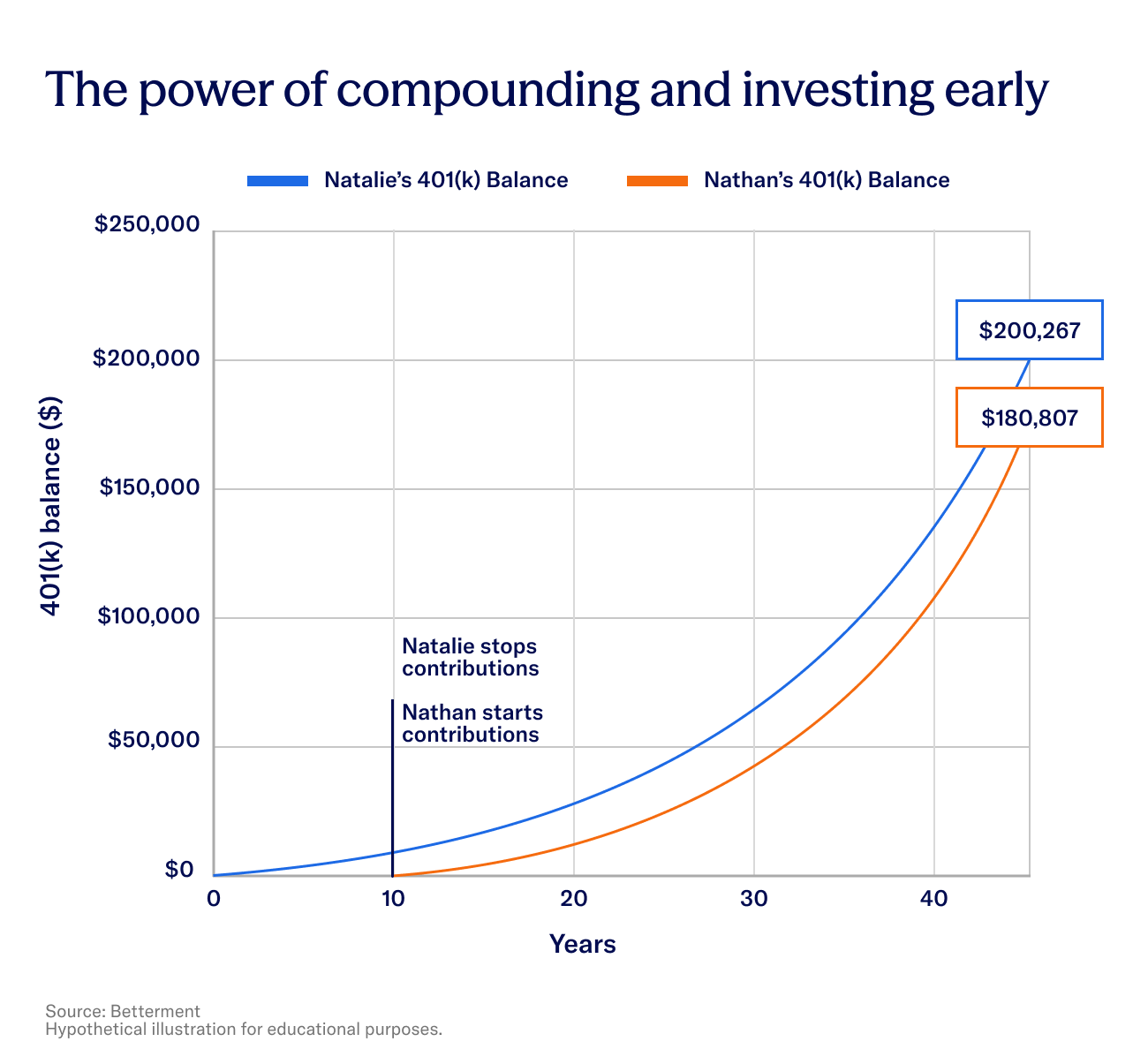
Source: Betterment. Hypothetical illustration for educational purposes only; assumes a 7% annual return and does not reflect any specific investment or Betterment product. Returns are not guaranteed and actual results will vary.
And you don't need a big paycheck to benefit. Small, automated amounts add up over time:
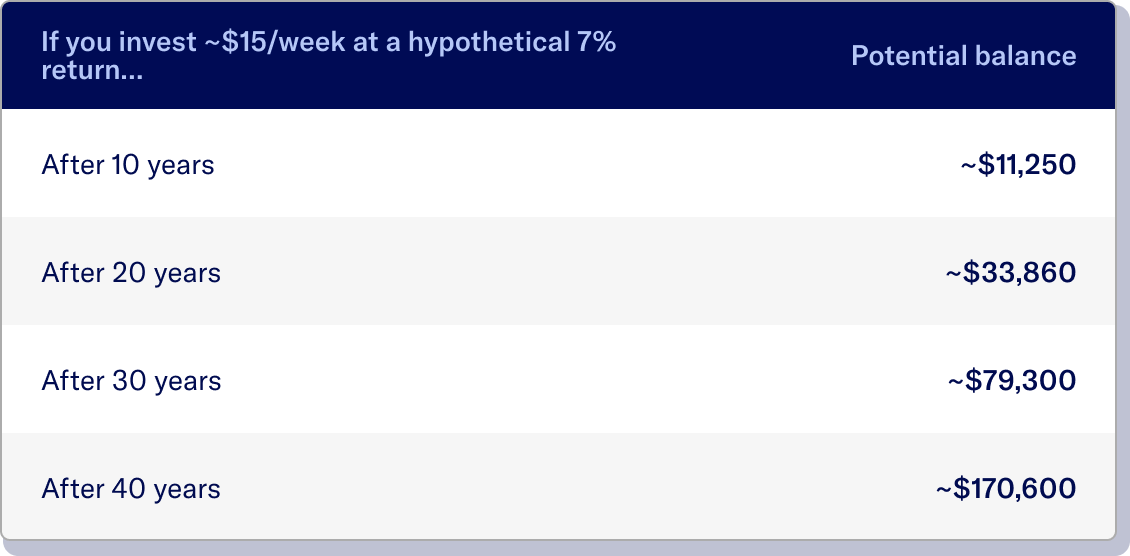
Hypothetical example for educational purposes. Does not represent the performance of any specific investment, portfolio, or Betterment product. Assumes a constant 7% annual nominal return, compounded monthly, with recurring contributions of $15 per week (approximated as a level monthly contribution) to a tax‑deferred investment account, and no employer contributions; returns are not guaranteed and actual results will vary. Figures exclude investment, plan, and advisory fees, taxes during accumulation, and inflation; returns are not guaranteed and actual results will vary. This example is not personalized advice and not a prediction of future results. Investing involves risk, taxes and penalties may apply upon distribution.
The takeaway: The dollar amount you start with matters far less than how early and how consistently you invest. Automating your contributions makes "consistent" the default and frees you from having to make the decision every month. (New to this? Start with Betterment's guide to investing in your 20s.)
Start growing your 401(k) savings with Betterment
Betterment is built to make all of this feel automatic. If your employer offers a 401(k) through Betterment, you can set a contribution rate, choose a portfolio matched to your timeline, and let it run—with auto-escalation available to nudge your rate up over time.
Ready to put your 20s to work? Contribute to your 401(k) today.