A tale of two tech sectors
It’s the best of times for big AI companies, but their smaller peers are feeling the squeeze. See how the divide is playing out and what it all means for your portfolio.Updated June 1, 2026 • 5 min read

- AI is getting so good at writing code that it's threatening the business model of companies that sell software for a living.
- Markets are already pricing in the disruption—software-focused stocks have diverged sharply from the broader tech sector over the past year.
- Despite the turbulence, the broader market remains near all-time highs, buoyed by strong corporate earnings growth at home and abroad.
- For diversified investors, broad market exposure is a built-in hedge. You don't have to bet on which companies will adapt and which won't.
Not long ago, one of the safest bets in tech was software. Scalable, sticky customers, high margins. Then AI got really good at writing code.
So much so that it’s quickly supplanting the output of human software engineers. Google recently revealed that 75% of its new code is now written by AI. One of the first victims of this technological revolution may ironically be the tech industry itself.
But if you’re one of the handful of companies with its own AI model, you’re still in pretty good shape. You own the tools to automate your computer engineering, and you can directly profit from others doing the same.
Other software companies, however, aren’t so lucky. The mere prospect of a DIY software future has turned investor sentiment against Software as a Service (SaaS) businesses like Adobe and Asana, raising predictions of what some are calling a “SaaSpocalypse.” Why pay for expensive enterprise software, the thinking goes, when you can build it yourself? Thanks to AI, in-house teams suddenly find themselves with a way more robust toolkit.

To see this trendline in action, look no further than two technology-minded funds: QQQ and IGV.
QQQ is made up of the 100 biggest non-finance companies listed on the Nasdaq stock exchange. Filtering out financial firms means it’s heavily concentrated in broad-based technology companies like Alphabet (Google), Amazon, and Microsoft. All big players in the AI arms race.
IGV, meanwhile, primarily holds just the software industry. Companies like Salesforce, Adobe, and Intuit. While many of them are racing to integrate AI into their products themselves, they don’t own the underlying technology.
These two funds have historically moved in lockstep. As goes software, so goes the broader technology sector. At least until recently. Something snapped late last year and that correlation broke down.
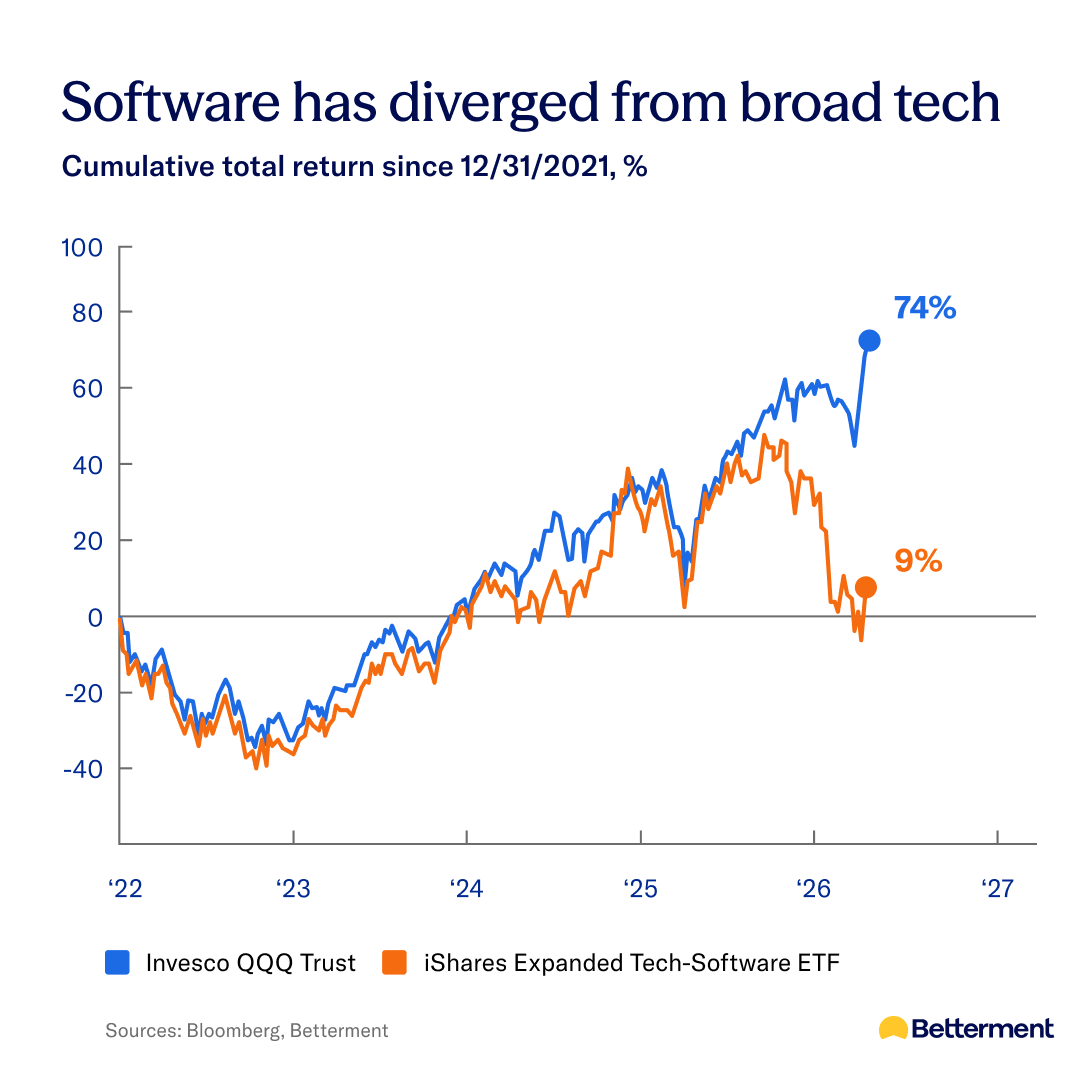
Many believe that "something" was Claude Code, a powerful AI coding tool released by Anthropic early in 2025 that surged in popularity near the end of the year. Claude Code has popularized the use of AI “agents,” autonomous helpers that can accomplish complex tasks on their own.
The investment research firm Citrini added fuel to the fire this past February with an alarming thought experiment called “The 2028 Global Intelligence Crisis." The report imagined a near future where AI agents steal the market share of not just SaaS companies but major tech and finance firms. For all of its alleged shortcomings in sound macroeconomic thinking, the paper went viral and moved markets. Looking back at the last 12 months, software-centric stocks have experienced brutal downturns in their share prices.
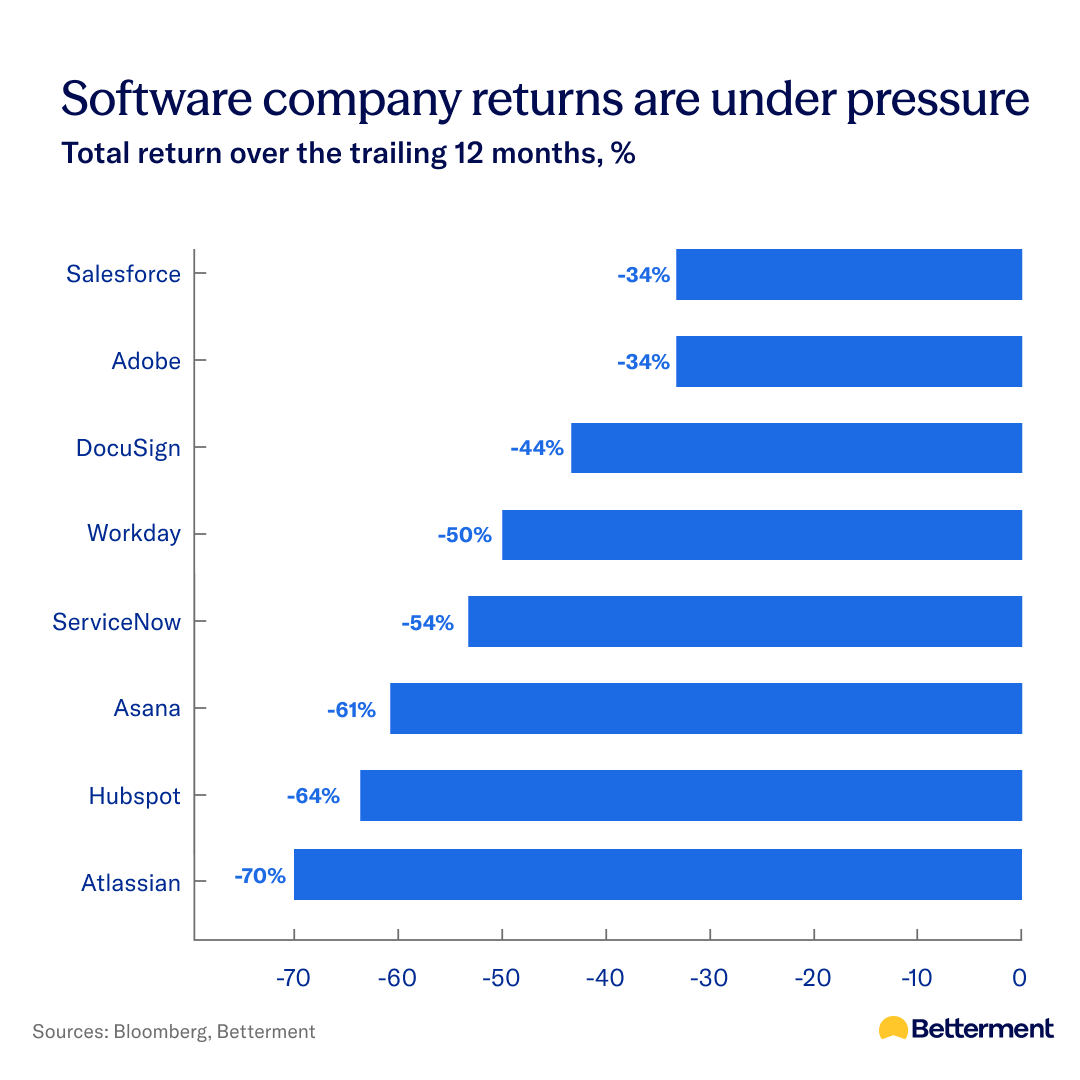
One way to look at this is simply the air being let out of inflated valuations in the software space. The sky isn’t falling, and it’s unlikely all of these businesses will suddenly go belly-up. Not all will adapt, but the benefit of investing in an index, or a market more broadly-speaking, is that you’re not pinning your portfolio’s dreams on one or a handful of companies.
So why then, with all of the uncertainties and headwinds out there, is the market at-large near all-time highs? Are we all just conditioned to blindly buy the dip? That could be part of it, but there's also something more fundamental going on in the form of strong corporate earnings growth.
While speculation and demand for stocks can drive up their prices, the fundamental driver of returns over the long term is growth in net income—companies’ ability to become more profitable. Even as the war in Iran drags on, analysts have revised up their estimates for earnings growth in 2026 after a strong year of growth in 2025. That's true across the board, with the U.S. as well as firms in Europe, Japan, and emerging markets forecasted to see an acceleration in profit growth. In spite of our unforced errors in the Middle East and the prospects of oil-induced inflation, it can still be a good time to invest globally for the long haul.
Go beyond software stocks with a global portfolio.
Ben is a member of Betterment's Investing team in the role of Sr. Investment Strategist. Previously, he worked on the data team at GiveDirectly, a nonprofit NGO that operates cash transfer and basic income programs. Prior to GD, he worked on the Private Bank Chief Investment Officer’s team at J.P. Morgan, contributing to the team's research, analysis, and content creation. Ben studied finance and history at the University of Virginia and is a CFA® charterholder and a CERTIFIED FINANCIAL PLANNER™ professional.