How much does a 401(k) cost an employer? (2025 guide)
A 401(k) can be affordable, especially when you understand where fees come from and how to leverage available tax credits.Updated December 15, 2025 • 5 min read

- A 401(k) can be affordable for small and mid-sized businesses—especially when you understand extra costs and avoid hidden fees.
- Employers typically budget for setup, administration, and investment-related fees, plus optional matching contributions.
- Betterment at Work provides transparent pricing and built-in compliance support, to help admin workload for employers.
- Small businesses may qualify for valuable SECURE Act tax credits that may significantly reduce or even eliminate plan costs in the first three years.
- Offering a 401(k) can help provide meaningful tax advantages for the business.
If you’re researching what a 401(k) costs small businesses, you’re not alone. Thousands of employers search for information on this topic every month because understanding plan costs can be confusing.
The truth is, a 401(k) can be affordable, especially when you understand where fees come from and how to leverage available tax credits.
Betterment at Work helps growing companies launch and manage scalable 401(k) plans built for their budget. Here’s what you need to know about 401(k) plan costs.
Why understanding 401(k) costs matters
According to the 2025 Betterment Retirement Readiness Report, a 401(k) is one of the most in-demand employee benefits.
Understanding 401(k) plan costs can help you:
- Attract and retain top talent
- Qualify for tax credits and deductions for your business
- Create an annual budget and avoid surprise fees as your plan grows
- Understand what it costs to stay compliant with IRS and DOL regulations
With Betterment, employers get transparent pricing with built-in compliance.
No more stressing over deadlines or handling reporting by yourself. Plus, no need to pay for extra 401(k) plan recordkeepers. We take care of your annual testing, daily monitoring, and complicated paperwork to confirm your 401(k) plan is compliant and up-to-date. See how we manage 401(k) plan compliance for you.
What does a 401(k) plan cost?
Generally, 401(k) costs usually fall into four categories:
- Setup and conversion fees: This covers plan design and onboarding, along with costs of converting a plan from another provider.
- Administration fees: Recordkeeping, reporting, employee support, compliance, payroll syncing make up the infrastructure that keeps your plan running smoothly.
- Investment fees: Costs of managing investments and fund-level expense ratios vary by plan complexity and are usually paid by employees, but employers influence these costs through their choice of plan providers.
- Employer contributions (optional): Many companies match employee contributions to boost participation and strengthen employee engagement. Employer contributions are tax-deductible, which can offset the overall plan cost.
Small business 401(k) cost estimates
401(k) plan costs can range depending on your business size and the plan provider you choose.
Cost type | Common cost range |
|---|---|
Setup and conversion fees | One-time fee of $500–$1,000+ |
Administration fees | $500-$10,000+ per year, depending on business size |
Investment fees | Average of 0.27% to 1.25% depending on plan size |
Employer contributions (optional) | Average of 4.8% in 2025 |
Cost type | Common cost range |
|---|---|
Setup and conversion fees | One-time fee of $500–$1,000+ |
Administration fees | $500-$10,000+ per year, depending on business size |
Investment fees | Average of 0.27% to 1.25% depending on plan size |
Employer contributions (optional) | Average of 4.8% in 2025 |
Betterment pricing is designed to scale with your business — not penalize you for growing. See Betterment at Work pricing.
How tax credits can pay for some (or all) of your 401(k) plan costs
One of the best-kept secrets in retirement benefits is tax credits.
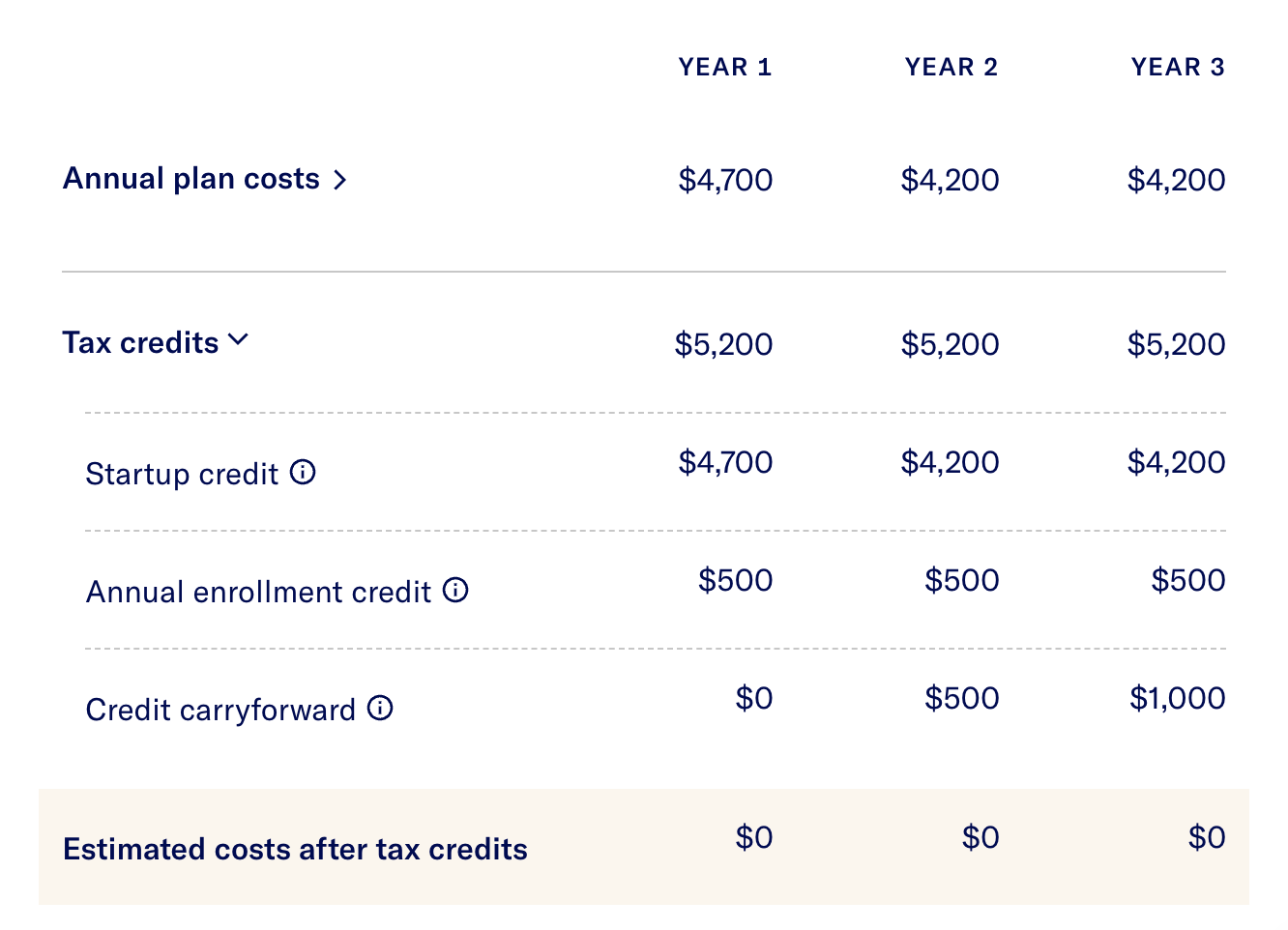
For example, a hypothetical company with 50 employees, where five of them earn $160,000 or more, may be able to have its plan expenses paid for by tax credits during the first three years of the plan.
Startup credit
Your plan may qualify for the start-up credit if it allows non-highly compensated employees (NHCEs) to participate and you have 100 or fewer employees.
- The startup credit is calculated based on the number of NHCEs in the plan and covers the costs of setting up and administering the plan, and educating employees.
- The possible annual credit is the greater of (1) $500 or (2) $250 per eligible NHCE, up to $5,000 per year. The maximum credit for a business is:
- With 51 to 100 employees: 50% of eligible startup costs paid or incurred in a tax year.
- With 50 or fewer employees: 100% of eligible startup costs paid or incurred in a tax year.
- If the plan’s administrative costs in a year are lower than the maximum allowable tax credit that year, the remaining credit may be rolled forward to a future year.
Auto-enrollment credit
You may qualify for the auto-enrollment credit if:
- You have added an Eligible Automatic Enrollment Arrangement (EACA) or Qualified Automatic Enrollment Arrangement (QACA) provision to your new or existing plan.
- You have 100 or fewer employees.
- You may qualify for the auto-enrollment credit even if your plan only allows participation by highly compensated employees.
{{banner_cta()}}
Kelly Chambers is a finance writer with two decades of leadership experience in the financial services industry. Along with Betterment, his work has included collaborations with leading financial brands such as Goldman Sachs, BlackRock, and Prudential.