Alternatives: What are they and how does Betterment use them?
Private equity and private credit are entering 401(k)s. Here are the diversification benefits, the liquidity risks, and the fees.Updated September 29, 2026 • 4 min read

Alternative investments were once limited to pension funds and institutional investors. New fund structures are changing that, and the conversation has reached 401(k) plans and target-date funds. Betterment recognizes their potential value in a diversified retirement portfolio, though we don't currently offer them in our core portfolios. Here's what alternatives are, what they offer, and what to weigh before they appear in a plan lineup.
What are alternatives?
Alternatives include any non-traditional investments beyond stocks, bonds, and cash: Private equity, private credit, hedge funds, commodities, cryptocurrency, real estate, infrastructure, and more. These kinds of investments typically move independently of public markets, which can make them valuable for portfolio diversification among other advantages.
However, alternatives might not be the right fit for every investor. Alternative investments can be more complex, less liquid, and often have higher fees associated with them.
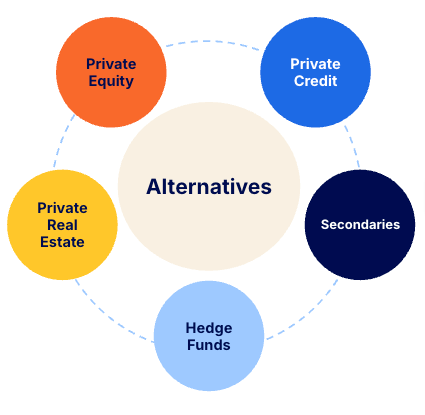
Other forms of alternatives: Commodities, crypto investments, collectibles, venture capital, real assets (infrastructure, natural resources), and more
What are the advantages of investing in alternatives?
Alternative investments generally do not correlate with the stock market, which means they can offer various benefits, such as:
- Growth potential: Alternatives have the potential to outperform traditional index funds, though results vary widely by manager and time period. This is largely because private markets are not bound to the same regulatory requirements as public investments. Alternatives often use active management in an attempt to outperform the market as opposed to matching it, the way an index fund does.
- Diversification: Alternatives like real estate and commodities often rise and fall at different times than stocks and bonds, which can smooth out a portfolio's overall swings. Some also tend to hold value when inflation is high.
- Broader access: Historically, alternatives were mainly available through vehicles reserved for institutions and ultra-high-net-worth investors. Today, individual investors can reach them through more accessible fund structures such as exchange-traded funds (ETFs).
What are the disadvantages of investing in alternatives?
Despite increased accessibility to investing in alternatives, meaningful caution still exists for the average investor:
- Liquidity constraints: Most alternatives cannot be bought or sold as quickly as stocks and bonds, which matters when participants need to access their retirement savings.
- Time horizon requirements: Many alternatives require a longer holding period to realize returns, which may not suit all investors.
- Complexity and transparency: Alternatives often lack real-time pricing transparency, making it difficult for investors to know the current value of their holdings. The complexity of these strategies often requires more education.
- Higher fees: Alternatives typically have high fee structures, which can meaningfully erode returns over the long run. This is a critical consideration for retirement savings.
- Correlation risk: During periods of market stress, correlations between alternatives and public markets can increase significantly, reducing the diversification benefit and potentially resulting in larger portfolio drawdowns than expected.
How are alternatives used in the retirement landscape today?
Pension funds were strong adopters of alternatives, allocating significant portions of portfolios to this asset class in order to optimize returns. This institutional practice has now cascaded into the broader 401(k) marketplace. Historically, only large institutional investors and pension funds could access alternatives due to high minimums and complexity. That landscape is shifting. Fund managers are innovating to improve liquidity management and transparency, making alternatives increasingly more practical for individual investors. For example, target-date funds are exploring strategic allocations to alternatives in the following ways:
- Early-career investors might see target-date funds allocate a small percentage of their portfolios to private equity and venture capital. This can capture high-growth premiums for investors who are decades away from retirement
- Funds may use real estate and infrastructure to hedge against inflation for mid-career investors
- For investors approaching retirement, target-date funds may use private credit or liquid alternatives to better manage volatility and generate additional income
How does Betterment think about alternatives in 401(k)s?
Betterment recognizes the potential value of alternatives in a diversified retirement portfolio. For Betterment 401(k) plans where we serve as the investment fiduciary, we continue to evaluate alternatives against our investment framework.
At this time, we do not offer alternative investment options in our core portfolios. We’re actively monitoring how the regulatory landscape evolves and how alternatives can responsibly be integrated into retirement plans. We'll continue to keep you informed as the industry innovates and our thinking develops.
You might also like



Daphne is a member of Betterment's Investing team, where she works as an Investments Associate. She joined from S&P Global, where she was a product analyst covering Totem Interest Rates Derivatives. At Betterment, she applies her portfolio analysis and market research background to support the firm's portfolio strategies, and she contributes commentary on market trends and the retirement landscape for Betterment's clients.