How plan conversions work at Betterment: A guide for advisors
Updated April 23, 2026 • 7 min read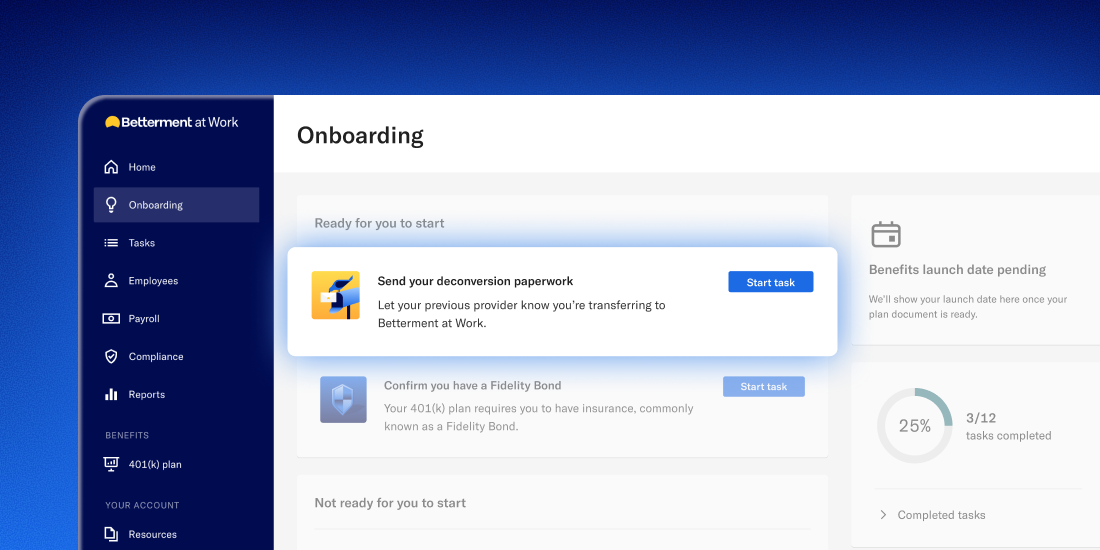

Your step-by-step guide to 401(k) plan conversions — what to expect, who does what, and how to keep things on track.
Plan conversions are one of the most complex transitions in the 401(k) world, and can be confusing for all involved: advisors, sponsors, and participants. Below, we’ll walk you through the full process so you can set accurate expectations with your plan sponsors and their participants from day one.
Your client’s onboarding specialist will also reach out to you and your client to schedule a kickoff call to discuss the onboarding process together. This call covers an overview of the onboarding process, estimated timelines, key milestones, and any questions you may have so that everyone is aligned.
Key: 🟠 Plan Sponsor | 🔵 Betterment | ⭐ Where advisors can help move things along
Step 1: Connect with the prior recordkeeper
🟠 The plan sponsor sends deconversion documents to the prior recordkeeper to officially initiate the transfer. Betterment should be included on those communications.
🔵 From there, your Betterment onboarding rep takes the lead, coordinating blackout period dates, ensuring required participant blackout notices are distributed (ERISA mandates advance notice), and aligning on asset liquidation and wire timing.
⭐ Advisors can help here by making sure the plan sponsor understands the urgency of getting those deconversion documents over to the prior recordkeeper as quickly as possible.These tasks account for a significant portion of the timeline. Recordkeepers move at their own pace and compliance timelines are non-negotiable, so getting the deconversion documents submitted promptly is one of the most important things to do right out of the gate.
Step 2: Review and finalize plan design and adoption agreement
🔵 Betterment's 401(k) Compliance Team provides a summary of the plan's current provisions and our onboarding rep walks the plan sponsor through it on a plan design review call to make sure everything looks correct and any changes are captured (advisors are encouraged to join this call as well). Once that conversation and attestation are complete, Betterment drafts the adoption agreement.
🟠 The plan sponsor reviews and signs the adoption agreement. This document must be fully executed before onboarding can move forward.
⭐ This is one of the most common places where timelines slip. Advisors can make a big difference by helping to keep the plan sponsor engaged and responsive. A slow turnaround on the adoption agreement can push the entire go-live date.
Step 3: Connect payroll
🟠 The plan sponsor kicks off the payroll integration directly in their Betterment dashboard and provides the necessary credentials and access.
🔵 Once initiated, the Betterment onboarding rep loops in our Payroll Integrations Team to work with the payroll provider on any more in-depth setup needs. Betterment will keep the plan sponsor and advisor in the loop throughout this process, scheduling a payroll integration call if needed. If the plan is not on an integrated provider, the plan sponsor will handle manual file uploads going forward.
⭐ Advisors can help by setting expectations with the sponsor upfront about the difference between integrated and non-integrated payroll and what each means for their day-to-day administrative experience.
Step 4: Create participant accounts and invite employees to claim
🔵 If the plan has a payroll integration, Betterment creates participant accounts automatically through the census data pulled via the integration. If not, accounts are created manually, which requires additional time and coordination.
🟠 In the onboarding dashboard, there is a task to invite employees to Betterment. When the plan sponsor completes this task, it triggers an automated email from Betterment to employees. They are instructed to claim their account, at which point they can review their deferral rate and make any updates before the first payroll run.
⭐ Advisors can help by encouraging the plan sponsor to remind employees to keep an eye out for their account access emails and to take action promptly.
Step 5: Adjust deferral rates
This is one of the most important things to communicate proactively to your plan sponsors and participants. Betterment does not map deferral rates from the prior recordkeeper.
🔵 Participants are prompted to review their current rate and update it to match what they had before or choose a new amount.
🟠 Plan sponsors should let their employees know as well so there are no surprises on the first payroll run.
⭐ Advisors can reinforce this message with both the sponsor and participants ahead of the switch. If the plan has auto-enrollment, all participants (including existing ones) will be enrolled at the plan's default auto-enrollment rate upon moving to Betterment. Getting ahead of this conversation will save a lot of confusion.
Step 6: Finalize fund lineup and map assets
🔵 Betterment applies the advisor-provided fund lineup and maps incoming assets to the chosen QDIA. Participants are defaulted into the QDIA and are prompted to review and update their investment elections after claiming their accounts. Here’s a short demo video of how they can do this. If the plan is using Betterment’s portfolios, participants are defaulted into the Core portfolio and can change their investment selection the same way.
It is important to note that this is not a participant-level like-for-like fund mapping, which is one of the most common misconceptions we see in a conversion.
⭐ Advisors should make sure the fund lineup is finalized during the sales process, before onboarding begins. Advisors are also best positioned to proactively explain the QDIA mapping process to sponsors and participants so it does not come as a surprise.
Step 7: Transfer funds and complete compliance review
🔵 The prior recordkeeper liquidates plan assets and wires the funds to Betterment. While the wire may arrive on a specific date, the plan will remain in blackout until our 401(k) Compliance Team has reviewed the transfer files. These files tell us how the wire amount is to be allocated across participants, and once the review is complete, assets are allocated accordingly. Our goal is to wrap up the blackout period within 10 business days of receiving the transfer files, though this is dependent on the quality and completeness of the reporting and can vary.
⭐ This step is largely on Betterment to manage, but advisors can be a helpful resource if there is additional intervention needed with the prior recordkeeper or if the plan sponsor needs extra support navigating the blackout period communications.
A couple of important things to communicate to plan sponsors and participants about the blackout period: Participants can continue to make new contributions throughout the blackout. The blackout restricts their ability to take distributions or change their investment selections, but paycheck contributions will continue to run.
Step 8: Invest assets and go-live
🔵 Once the wire clears and Compliance completes their review, assets are invested per the approved fund lineup. Participants are notified and can log in to view their accounts, confirm their investments, and make any final adjustments.
Step 9: Schedule a participant education session
🔵 Before or around the go-live date, Betterment's Client Success Manager will reach out to the sponsor and advisor to schedule a participant education session to help employees understand the plan, how to enroll, and what to expect.
⭐ Advisors are encouraged to join as a co-host, and while it is not required, it is a great way to showcase the advisor-Betterment partnership and be available to field any investment-related questions in real time.
What to tell your plan sponsors before conversion begins
Setting expectations early makes the whole process smoother for everyone. Here are the key takeaways:
- Getting deconversion documents to the prior recordkeeper quickly and executing the adoption agreement promptly are the two biggest things a plan sponsor can do to keep the timeline on track.
- Deferral rates will not carry over and participants will need to update them when they receive account access.
- Fund mapping goes to the QDIA, not like-for-like from the prior plan.
- During the blackout period, participants cannot take distributions or change their investment elections, but contributions will continue as normal.
- The blackout will remain in place until Betterment's 401(k) Compliance Team completes their review of the transfer files, with a goal of wrapping up within 10 business days of receipt.